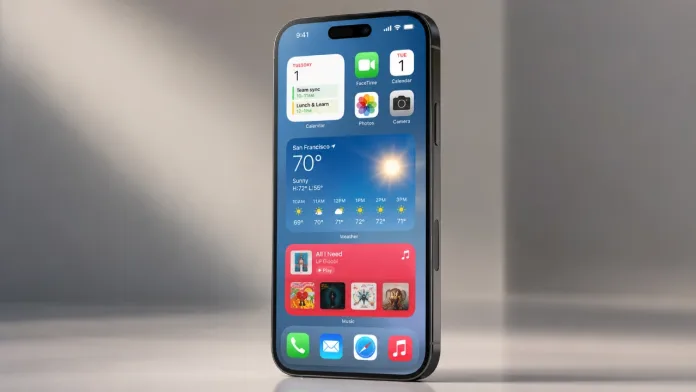


Some Apple updates make noise the moment they appear on stage. Others look almost minor at first, then quietly change the way people use their devices every day. The new handling of iPhone Mirroring in macOS 27 Golden Gate clearly belongs to the second group.
With this release, Apple finally lets users resize the iPhone Mirroring window with new display formats, instead of simply scaling a window locked to the iPhone’s natural proportions. Until now, mirroring the iPhone on a Mac still felt quite rigid: useful for replying to a message, opening an app or checking a notification, but rarely comfortable for longer sessions. macOS 27 changes that logic by introducing different aspect ratios, better suited to real use cases and compatible apps.
A small window becomes a real workspace
iPhone Mirroring is not just basic screen duplication in the AirPlay sense. Apple’s idea is to let users wirelessly interact with their iPhone, its apps and notifications from the Mac, while the iPhone itself remains locked. That detail is exactly what makes the feature interesting: you are not just “projecting” your phone, you are using it almost like an extension of the desktop.
The issue, until now, was space. An iPhone app inside a vertical window works fine for Messages or Notes, but much less so for apps that need room to breathe: file managers, social networks, dashboards, work chat apps, banking tools or travel apps. macOS 27 gives users more flexibility by changing the window format. This does not appear to be completely free resizing, but rather a set of fixed formats that the window can automatically adapt to.
That feels very Apple: less permissive than fully free resizing, but cleaner, more predictable and probably more reliable for the interface.
The real message is aimed at developers
This update is not just about Mac users. It also sends a pretty clear signal to developers: iPhone apps can no longer be designed only for a fixed vertical rectangle.
Apple is pushing developers to build apps that can adapt to a dynamic range of sizes and proportions. The idea goes beyond iPhone Mirroring. It also touches iPad, Xcode simulators and, very likely, future devices with variable screen formats.
The interesting part is that some apps may show an adjusted iPhone interface, while others could use their iPad interface when one exists. For users, that can turn a slightly cramped mobile app into a much more comfortable window on the Mac. For developers, it means cleaning up interfaces that are too rigid.
The foldable iPhone shadow over macOS 27
This update could be seen as a simple comfort improvement for Mac. But that would miss the bigger picture. For months, rumors about a foldable iPhone have kept resurfacing, and iOS 27 seems to be preparing the software side. References such as “foldState” and “angleDegrees” have reportedly appeared in iOS 27 frameworks, feeding the idea of a device capable of physically changing angle or format.
Apple never announces this kind of product ahead of time. But the company often prepares the ecosystem before revealing the hardware. Here, making iOS apps more flexible on Mac and iPad looks a lot like a rehearsal. A foldable iPhone would need apps capable of moving from a compact layout to a wider interface without breaking the experience.

To me, this is the most interesting part of the announcement. macOS 27 is not just improving a nice but limited feature. It is part of a broader shift: iOS moving toward less rigid formats.
A feature still limited, especially in Europe
Not everything is perfect. First, the new ratios seem to be reserved for apps compatible with iOS 27, at least for now. Third-party apps will need to catch up. Then there is the major limitation for European users: iPhone Mirroring is still not officially available in the European Union.
That is frustrating, because the feature is becoming more mature just as part of the audience still cannot use it. For a user in the United States, macOS 27 makes the iPhone much more present on the Mac. For a European user, it remains mostly a promise worth watching.
Final thoughts
This evolution of iPhone Mirroring is not a flashy revolution, but it moves in a very interesting direction. Apple is making the iPhone less trapped inside its own screen, the Mac less isolated from the mobile ecosystem and iOS apps more adaptable.
The most revealing part is not the resizable window itself. It is what it says about what comes next: an Apple more focused on hybrid formats, cross-device workflows and, perhaps, a future foldable iPhone. macOS 27 Golden Gate may end up being less minor than it first appears.
FAQ
Does iPhone Mirroring now allow fully free resizing?
Not exactly. macOS 27 appears to offer several fixed formats rather than pixel-perfect free resizing.
Will all iPhone apps be compatible?
No. The new formats mostly apply to apps compatible with iOS 27, with gradual adoption expected from third-party apps.
Is the feature available in Europe?
At the moment, iPhone Mirroring is still not officially available in the European Union.
Does this update hint at the foldable iPhone?
Apple has not confirmed that. But the added interface flexibility in iOS 27 and macOS 27 clearly looks like software preparation.

I'm Clémentine Pithon, and as a technology enthusiast, I write articles to guide you through the world of refurbished devices. My goal is simple: to help you make informed choices, understand the products, and get the most out of them every day. Tips, explanations, and practical advice are at the heart of my articles.