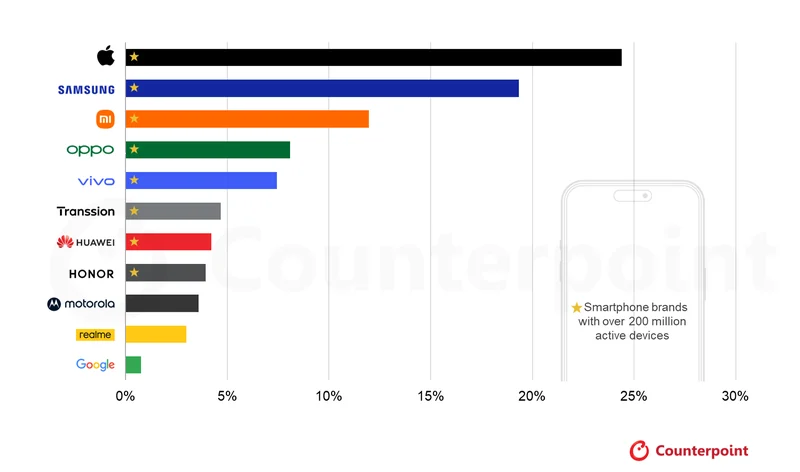
In a market that’s becoming more and more polarized, a recent number puts Apple in an even stronger position than the usual “who sold the most this quarter” debate: roughly one in four active smartphones worldwide is said to be an iPhone. The figure comes from Counterpoint Research’s installed-base tracking and has been echoed by several tech outlets. And it tells a different story than annual sales: this is about the phones people are actually using day to day, not just what shipped recently.
It sounds like a small nuance, but it’s not. Because sales and active usage are two different realities. If Apple accounts for that big a slice of what’s in people’s hands, it’s not only because it sells a lot — it’s also because iPhones stay in circulation longer.
Apple and the power of the installed base
The key concept here is the active installed base: all smartphones still in use today, worldwide. And within that “rolling fleet” of devices, iPhone is estimated to represent about 25%. In other words: even though Android remains the dominant OS overall (because it powers countless brands across every price tier), Apple has massive weight as a single manufacturer.
Samsung is still the closest rival in installed base, but typically below Apple on this specific metric. Where Apple really pulls ahead is continuity: fewer models, long software support, strong resale value, and user loyalty that sometimes looks less like passion and more like a gentle kind of gravity. You get in… and you tend to stay.
This isn’t just “Apple is popular.” It’s closer to: Apple is entrenched.
Why iPhones stick around longer
To understand that 25%, you have to look at lifecycle.
iPhones tend to remain in active use longer than many Android phones. Not because they’re magical, but because:
- iOS updates last for years (often 5–6 years or more depending on the model).
- Performance ages well: iOS is built for a relatively narrow set of hardware, so optimization is tighter.
- Resale value stays high: older iPhones circulate more through family hand-me-downs, secondhand markets, and refurb channels.
- Year-to-year upgrades are less “must-have”, so people hang onto devices for 3–4 years (sometimes longer).
The result is simple: even if Apple weren’t outselling everyone every year, its active footprint could still grow, because iPhones exit the ecosystem more slowly.
Ecosystem and services: the quiet advantage
This is probably the most important piece — and the one people often reduce to “AirDrop, sure.”
Apple has built an ecosystem where the iPhone isn’t a standalone product anymore; it’s a hub:
- iCloud (backups, photos, documents)
- Apple Watch (health, safety, notifications)
- AirPods (automatic switching, calls, spatial audio)
- Mac / iPad (Continuity, clipboard, calls, messages, file sharing)
- Apple Pay, media services, subscriptions
Each piece reinforces the others. And the more Apple devices you add, the higher the practical (and psychological) cost of switching. I’m not saying that’s good or bad — I’m saying it’s effective.
This kind of integration creates loyalty that isn’t only emotional. It becomes functional.
Android, Samsung: a useful comparison (without the clichés)
Quick reminder: Android dominates globally because it powers hundreds of brands and covers everything from ultra-budget to ultra-premium. But that strength comes with trade-offs:
- Fragmentation (wildly different experiences across devices)
- Uneven update policies depending on brand and price tier
- Shorter software lifespan for many mid/low-end phones
- Lower resale value in many markets
Samsung is arguably the most “Apple-like” Android brand in some respects: strong premium lineup, improved update commitments on newer models, and a growing ecosystem (watches, earbuds, tablets). Still, Samsung operates within Google’s Android world, while Apple controls the whole stack end-to-end.
What’s interesting is that the market increasingly isn’t decided by a single spec (camera, nits, megapixels). It’s decided by who can keep users.
What this means for users
A bigger iPhone footprint in the active base has real-world consequences.
For iPhone users:
- Longer device lifespan, longer OS support, better resale value
- A more consistent software experience
- Deeper service integration (which can feel convenient… or a bit sticky)
For Android users:
- More choice, more experimentation (foldables, wild zooms, giant batteries)
- More freedom to customize
- But more variability depending on brand
For everyone:
- Developers often treat iPhone users as a high-value audience
- Accessories and the “phone-adjacent” industry align around Apple’s ecosystem
- De facto standards (sharing, payments, messaging habits) bend toward Apple’s choices
That’s where “25%” stops being a trivia stat and starts being structural.
Trends pushing Apple upward
Several trends are quietly boosting Apple:
- Hardware innovation feels less dramatic, so people upgrade less often
- Refurbished phones are booming, and iPhones do exceptionally well there
- Services/subscriptions make ecosystems stickier over time
- Perceived security + simplicity remains a major driver for mainstream buyers
- On-device AI could favor vertically integrated players (chip + OS + apps)
There’s also a cultural effect: in many markets, once you move into the higher price tiers, iPhone becomes the default choice for a lot of people.
The challenges ahead
Even with these numbers, Apple has real headwinds:
- Pricing pressure (components, logistics, mature markets, aggressive competition)
- Regulatory scrutiny (App Store rules, interoperability requirements, etc.)
- Stronger premium competition from Chinese brands in certain regions
- Smartphone saturation: most people already have a “good enough” phone
This shifts the strategic question: does Apple need to sell vastly more iPhones, or just maintain a huge active base that generates recurring services revenue? Personally, I think the second strategy is already the real one.
FAQ
1) What does “active installed base” actually mean?
It’s the number of smartphones still being used today, not just recently sold. A 2019 phone counts if it’s still active.
2) Why does iPhone represent such a big share of the installed base?
Long software support, better long-term performance, high resale value, and strong secondhand/refurb circulation.
3) Is Android “losing”?
Not overall — Android still dominates globally. But no single Android maker matches Apple’s unified ecosystem and long-term consistency at scale.
4) Does this mean everyone will switch to iPhone?
Not necessarily. Price-sensitive markets still heavily favor Android, structurally.
5) Will this trend continue?
Likely, as long as iPhones keep lasting longer and the ecosystem remains compelling. Big disruptions (pricing, regulation, new form factors) could slow it down.
Final toughts
That “one in four” stat feels less like a flashy marketing win and more like a signal: the smartphone has become a stable, long-life object — closer to a router or a laptop than a yearly fashion item. In that world, Apple’s strategy works: fewer models, long updates, strong resale value, and a user experience that rarely feels “old” too quickly.
It’s also a kind of soft dominance. Not the loud kind that screams “we won,” but the quiet kind that becomes habit. And once a product becomes habit, it’s hard to displace. Apple’s challenge isn’t only to sell more — it’s to keep giving people reasons to stay without making it feel like a gilded cage.